What Is the Mean in Math?
The mean is the average you get by sharing a total out equally. Here is the definition in plain words, the symbols, a first worked example — and the mean of fractions, decimals and negative numbers.
The mean in plain words
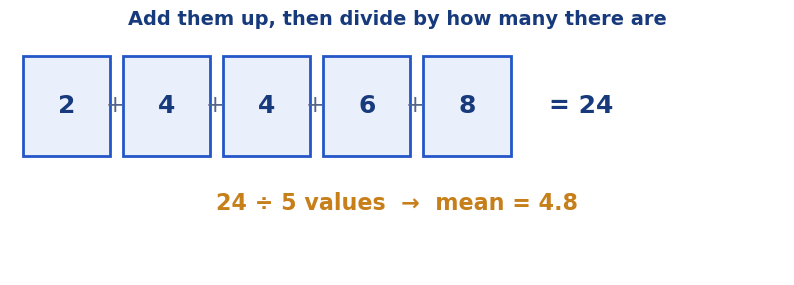
In math, the mean of a set of numbers is what you get when you add all the numbers together and divide by how many there are. Five friends score 2, 4, 4, 6 and 8 points in a game — 24 points between them. Shared out equally, that is 24 ÷ 5 = 4.8 points each. Nobody actually scored 4.8, and that is the first thing to understand: the mean does not have to be one of the numbers, or even a whole number. It is the balance point of the data — lay the values on a number line and the mean is where the line would balance. The mean calculator on this site finds it from any list you paste; this page is about what the answer means.
The formula and the symbols
The mean is written as a short formula: x̄ = Σx ÷ n. The symbol x̄ (read "x-bar") is the mean itself; Σ (the Greek letter sigma) means "add everything up", so Σx is the sum of all the values; and n is how many values there are. For the game scores: Σx = 24, n = 5, and x̄ = 24 ÷ 5 = 4.8. One more symbol appears when the numbers cover a whole group rather than part of one: the population mean is written μ (mu) instead of x̄ — same calculation, different label. Our mean formula reference breaks each version of the formula down with its own worked example.
A first worked example, slowly
Set: 2, 4, 4, 6, 8. Step 1 — count: there are 5 numbers, so n = 5. Step 2 — add: 2 + 4 + 4 + 6 + 8 = 24. Step 3 — divide: 24 ÷ 5 = 4.8. Then the sanity check every mean deserves: the answer must sit between the smallest value (2) and the largest (8) — 4.8 does — and near the middle of the pack, which it is. The full method, with the mistakes to avoid, is in our guide on how to calculate the mean; the three steps never change, whatever the numbers.
The mean of fractions and decimals
The method is identical when the values are not whole numbers — only the addition needs care. Fractions: for 1/2, 1/4 and 3/4, the sum is 1.5 (write them as 2/4 + 1/4 + 3/4 = 6/4), and 1.5 ÷ 3 = 0.5 — exactly 1/2, neatly inside the set. Decimals: for 2.5, 3.5 and 4.0, the sum is 10.0 and 10 ÷ 3 = 3.33 (3.333… before rounding — round only at the end, never mid-calculation). If fractions and decimals mix, convert everything to decimals first, then add: one consistent form keeps the arithmetic honest.
The mean of negative numbers
Negative numbers join in exactly the same way, because adding a negative is subtracting. For −4, 2 and 5: the sum is −4 + 2 + 5 = 3, and 3 ÷ 3 = 1. The mean can itself be negative — winter temperatures of −2, −5 and −3 average to −10 ÷ 3 = −3.33 — and it can be zero, when the positives and negatives cancel exactly, as in −6, 0 and 6. The one habit worth building: pair off positives and negatives as you add, so a stray sign never survives to the division step.
Mean vs average: same thing?
In everyday language, yes: when people say "average" they almost always mean the mean. In statistics the word is looser — the median (the middle value) and the mode (the most common value) are also called averages in the broad sense, because all three summarize a set with one typical number; together they are the measures of central tendency. That is why textbooks prefer "mean" when precision matters: it names exactly one calculation. Worked sets of every kind — including the exact "what is the mean of…" questions students search for — are collected in our mean examples.
More guides
Frequently asked questions
What does mean mean in math?
In math, the mean of a set of numbers is the sum of the numbers divided by how many there are — the average you get by sharing the total out equally. For 2, 4, 4, 6 and 8, the sum is 24 and the count is 5, so the mean is 24 ÷ 5 = 4.8.
What is the mean of 2, 4, 4, 6, 8?
Add them up: 2 + 4 + 4 + 6 + 8 = 24. Divide by the count of 5: 24 ÷ 5 = 4.8. The mean is 4.8 — a value that is not itself in the set, which is completely normal.
Is the mean always one of the numbers in the set?
No. The mean is a balance point computed from the data, not a member of it. It only has to fall between the smallest and largest values — in the example above, 4.8 sits between 2 and 8 without being one of the values.
What is the difference between the mean and the median?
The mean uses every value: it is the sum divided by the count, so extreme values pull it. The median uses position only: it is the middle value of the sorted data, so extreme values barely move it. Both are called averages; the mean is the one everyday language usually intends.