The Mean Formula
One formula — add everything up, divide by how many there are — plus its population, weighted and grouped-data forms, each with a worked example.
The mean formula
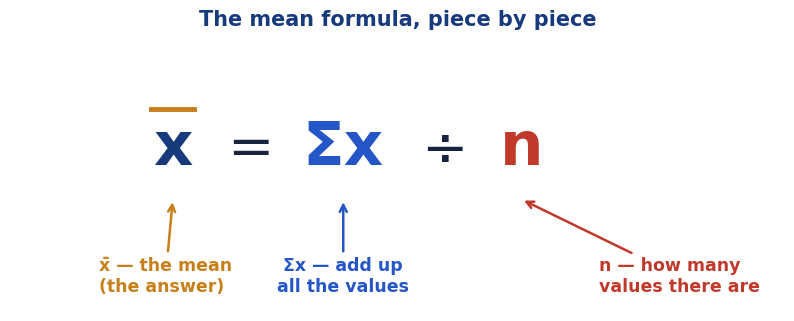
Add up all the values (Σx) and divide by how many values there are (n). That is the entire formula — everything else in statistics is detail about doing it carefully.
The three symbols each carry one idea. x̄ ("x-bar") is the mean itself — the answer. Σ is the Greek capital letter sigma, the standard symbol for "add everything up", so Σx means the sum of all your values. n is the count — how many values you added. Read aloud, the formula says: the mean equals the sum of the values divided by the count. Our mean calculator applies it the moment you paste, steps included; this page is the reference for what it is doing.
The formula at work
For the values 4, 8 and 15: Σx = 4 + 8 + 15 = 27, and n = 3. So x̄ = 27 ÷ 3 = 9. Two things worth noticing. First, the formula needs only two ingredients — a total and a count — which is why a mean can be updated without the original list if you know both. Second, 9 is not one of the values: the mean is a balance point computed from the data, not a member of it. Longer lists change nothing about the method — the eight test scores used across this site give Σx = 685 and n = 8, so x̄ = 685 ÷ 8 = 85.625.
The population form: μ = Σx ÷ N
When the data covers an entire population rather than a sample, the same formula is written with different symbols: the mean becomes μ (the Greek letter mu) and the count becomes N. The arithmetic does not change at all — only the label, marking that no sampling is involved. Example: a store's complete season of monthly sales — 65, 70, 72, 75, 80, 88 — gives Σx = 450 and N = 6, so μ = 450 ÷ 6 = 75. The population mean calculator uses this framing throughout, and our sample vs population guide explains when each symbol is the honest one to use.
The weighted form: Σ(x × w) ÷ Σw
When some values should count more than others, each value is multiplied by its weight w before summing, and the divisor becomes the sum of the weights: weighted mean = Σ(x × w) ÷ Σw. Course grades are the standard case: scores of 90, 84 and 78 carrying weights of 20%, 30% and 50% give (90 × 0.2) + (84 × 0.3) + (78 × 0.5) = 18 + 25.2 + 39 = 82.2, and since the weights sum to 1, the weighted mean is 82.2 — below the plain mean of 84, because the weakest score carried the heaviest weight. The weighted mean calculator and our weighted average guide work this form in full.
The grouped-data form: Σf·x ÷ Σf
Data that arrives already counted — a frequency table — uses a cousin of the formula: multiply each value x by its frequency f, add the products, and divide by the total frequency: mean = Σf·x ÷ Σf. For grouped classes, where the original values are lost inside ranges like 0–10, each class is represented by its midpoint. Classes 0–10, 10–20 and 20–30 (midpoints 5, 15, 25) with frequencies 3, 5 and 2 give Σf·x = 15 + 75 + 50 = 140 and Σf = 10, so the estimated mean is 14 — an estimate, because midpoints stand in for values nobody recorded exactly. The mean calculator with frequency handles both the plain and grouped forms, and the frequency table guide explains the traps.
What the formula does not tell you
The formula is blind in one important way: every value counts equally, so one extreme value moves the answer like any other. It also says nothing about shape — two data sets with the same Σx and n share a mean even if one is tightly packed and the other is split between extremes. That is why the mean travels with companions (the median for shape, the standard deviation for spread) and why our step-by-step guide to calculating the mean ends with a sanity check: the answer must always fall between the smallest and largest values. New to the idea itself? Start with what the mean is in math, then come back to the formula.
More guides
Frequently asked questions
What is the formula for the mean?
x̄ = Σx ÷ n: add up all the values (Σx) and divide by how many values there are (n). For 4, 8 and 15, Σx = 27 and n = 3, so the mean is 27 ÷ 3 = 9.
What does Σ mean in the mean formula?
Σ is the Greek capital letter sigma, the standard mathematics symbol for "add everything up". Σx means the sum of all the values in the data set.
What is the difference between x̄ and μ in the mean formula?
They are the same calculation with different labels. x̄ (x-bar) is the mean of a sample — part of a group — while μ (mu) is the mean of a whole population, written with N for the count. The arithmetic, sum divided by count, is identical.
How do you find the mean if you only know the sum and the count?
That is all the formula needs: divide the sum by the count. A sum of 685 over a count of 8 gives 685 ÷ 8 = 85.625, without ever seeing the individual values.