Mean, Median, Mode and Range
The four numbers that summarize a data set in every school course — learned together on one set of data, with practice questions (and full answers) at the end.
The four measures together
School statistics introduces four summaries as a set: the mean, the median, the mode and the range. The first three are measures of central tendency — each names a "typical" value in a different way. The mean shares the total out equally; the median takes the middle value of the sorted data; the mode takes the most common value. The range is the odd one out: it measures spread, not center — the distance from the smallest value to the largest. Learn the four as one toolkit and most introductory data questions become routine. The mean median mode calculator computes all four from one paste; this guide is for learning to do it by hand.
One data set, all four answers
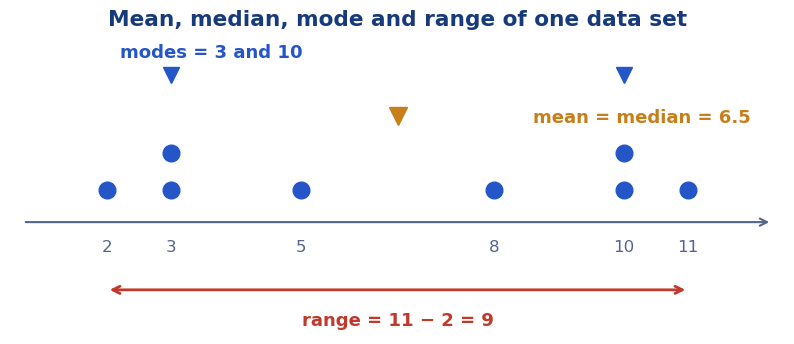
Data set: 2, 3, 3, 5, 8, 10, 10, 11 (already sorted). Mean: the sum is 52 and the count is 8, so the mean is 52 ÷ 8 = 6.5. Median: with an even count, average the two middle values — the 4th and 5th are 5 and 8, so the median is (5 + 8) ÷ 2 = 6.5. Mode: count the repeats — 3 appears twice and 10 appears twice, so the set is bimodal with modes 3 and 10. Range: largest minus smallest, 11 − 2 = 9. Mean 6.5, median 6.5, modes 3 and 10, range 9 — one set, four answers, each found by a different route.
Formula recap
| Measure | How to find it | Watch out for |
|---|---|---|
| Mean | Sum of values ÷ count | Extreme values pull it; check it lands between min and max |
| Median | Middle value of the sorted data (average the middle pair if the count is even) | Forgetting to sort first — the classic error |
| Mode | The value that appears most often | There may be two modes, several, or none at all |
| Range | Largest value − smallest value | One extreme value stretches it — it says nothing about the middle |
Order of work that never fails: sort first (the median and range both need the sorted list), count as you go (the mode is a counting exercise), and total last (the mean needs the sum and the count). Three of the four answers fall out of one sorted list and one running total.
Practice questions
Question A: 5, 7, 7, 9, 12. Sum = 40, count = 5, mean = 40 ÷ 5 = 8. Sorted, the middle (3rd) value is the median, 7. The mode is 7 (it appears twice). Range = 12 − 5 = 7. Mean 8, median 7, mode 7, range 7.
Question B: 14, 18, 22, 22, 30, 36. Sum = 142, count = 6, mean = 142 ÷ 6 = 23.67. The middle pair is 22 and 22, so the median is 22. The mode is 22 (twice). Range = 36 − 14 = 22. Mean 23.67, median 22, mode 22, range 22 — notice the single 36 pulling the mean above the other three.
Question C: 3, 6, 9, 12. Sum = 30, count = 4, mean = 30 ÷ 4 = 7.5. The middle pair is 6 and 9, so the median is (6 + 9) ÷ 2 = 7.5. Every value appears once, so there is no mode. Range = 12 − 3 = 9. An evenly spaced set: mean and median agree exactly, and "no mode" is a complete answer, not a missing one.
Where students lose marks
The recurring traps are few and fixable. Not sorting before taking a median. Stopping at one mode when two values tie — always check the full tally. Reporting the mean of the extremes — (min + max) ÷ 2 — as "the mean": that number is the midrange, a different measure. And averaging the four answers together into a single "overall average", which means nothing at all. Our mean calculation mistakes guide covers the wider family, the range calculator isolates the spread measure, and the deeper three-way comparison lives in mean, median and mode compared.
More guides
Frequently asked questions
What are the mean, median, mode and range of 2, 3, 3, 5, 8, 10, 10, 11?
Mean 6.5 (the sum 52 divided by the count 8), median 6.5 (the average of the two middle values, 5 and 8), modes 3 and 10 (each appears twice, so the set is bimodal), and range 9 (11 − 2).
Which of the four measures is not a measure of central tendency?
The range. The mean, median and mode each describe the center of a data set; the range describes its spread — the distance from the smallest value to the largest — and says nothing about where the middle lies.
Can the mean, median and mode all be the same number?
Yes. On symmetric data they often coincide: for 3, 5, 5, 7 the mean is 5, the median is 5 and the mode is 5. Agreement among the three is a sign the data is evenly balanced around its center.
How do you remember the difference between the median and the mode?
Median sounds like medium — it is the middle value. Mode sounds like most — it is the most common value. If you remember "median = middle, mode = most", the two never get swapped.