How to Calculate a Weighted Average
Values times weights, divided by total weight — with a course-grade example worked in full and the GPA connection explained.
Why a plain mean is not always fair
A plain mean treats every value as equally important. Often that is wrong by design: a final exam is supposed to matter more than a homework set; a 4-credit course is supposed to move a GPA more than a 2-credit one; a class of 30 is supposed to count for more than a class of 10. The weighted average is the mean with that importance built in — each value multiplied by a weight before averaging. The weighted mean calculator runs the method below on your own rows; this guide is the by-hand version.
The weighted average method
Multiply each value by its weight, add the products, divide by the total weight.
Step 1 — Multiply each value by its weight. Step 2 — Add the products (Σ(x × w)) and, separately, the weights (Σw). Step 3 — Divide the first total by the second.
Worked grade example
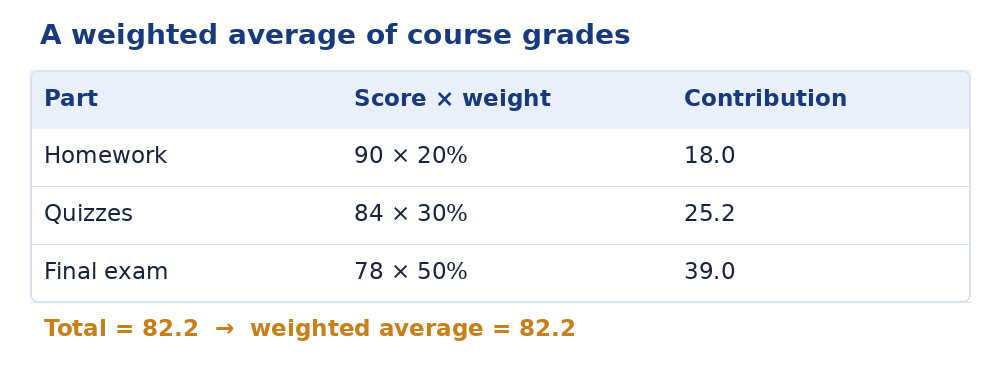
Homework 90 (worth 20%), quizzes 84 (30%), final exam 78 (50%):
- 90 × 0.20 = 18
- 84 × 0.30 = 25.2
- 78 × 0.50 = 39
- Σ(x × w) = 82.2, Σw = 1 → weighted average = 82.2
The simple average of the same three scores is 84. The weighting pulls the answer down by 1.8 points because the weakest performance carries the heaviest weight. Neither number is "wrong" — but only one of them is the grade the course actually awards.
Weighted average vs weighted GPA
GPA is the same machine with specific parts: values are grade points (A = 4.0, B = 3.0, C = 2.0, D = 1.0, F = 0.0) and weights are credit hours. A semester of A (3 credits), B (4 credits), A (3 credits), C (2 credits) gives (12 + 12 + 12 + 4) ÷ 12 = 3.33. The full method — semester and cumulative, weighted vs unweighted GPA — is worked in how to calculate your GPA. The trap that catches everyone once — averaging two averages without their weights — is dissected in the mean mistakes guide.
Weighted averages everywhere
Once you see the pattern, it is everywhere. A portfolio's return is its assets' returns weighted by their shares. A course's final grade is its components weighted by their syllabus percentages. A country's published "average" survey result is its respondents weighted to match the population. Even this guide's own example — two classes of 10 and 30 students averaging 80 and 60 — is a weighted average waiting to happen: (10 × 80 + 30 × 60) ÷ 40 = 65. The plain mean is just the special case where every weight happens to be equal. When a problem gives you groups, percentages, credits, hours or importance of any kind, it is asking for the weighted version — run it through the weighted mean calculator and read the multiplication table it builds.
More guides
Frequently asked questions
How do you calculate a weighted average?
Multiply each value by its weight, add the products, and divide by the sum of the weights: Σ(x × w) ÷ Σw.
Do weights need to sum to 100?
No. Dividing by the sum of the weights normalizes any set — 2, 3, 5 works exactly like 20%, 30%, 50%.
What is the weighted average of 90, 84 and 78 weighted 20%, 30%, 50%?
18 + 25.2 + 39 = 82.2 — lower than the simple average of 84, because the biggest weight sits on the lowest score.
Is a GPA a weighted average?
Yes: grade points weighted by credit hours. A 4-credit A counts twice as much as a 2-credit A.