Arithmetic Mean vs Geometric Mean
Add-and-divide versus multiply-and-root: why growth rates need the geometric mean, with a three-year returns example where the two disagree.
The difference
Both are "averages", but they average different operations. The arithmetic mean assumes the values add: it finds the equal share of a total. The geometric mean assumes the values multiply: it finds the equal factor that, applied repeatedly, produces the same final result. Scores on a test add; investment returns multiply. Picking the wrong one does not give a slightly-off answer — it answers a question nobody asked. Both are computed, with steps, on this site: the arithmetic mean calculator and the geometric mean calculator.
Why growth rates need the geometric mean
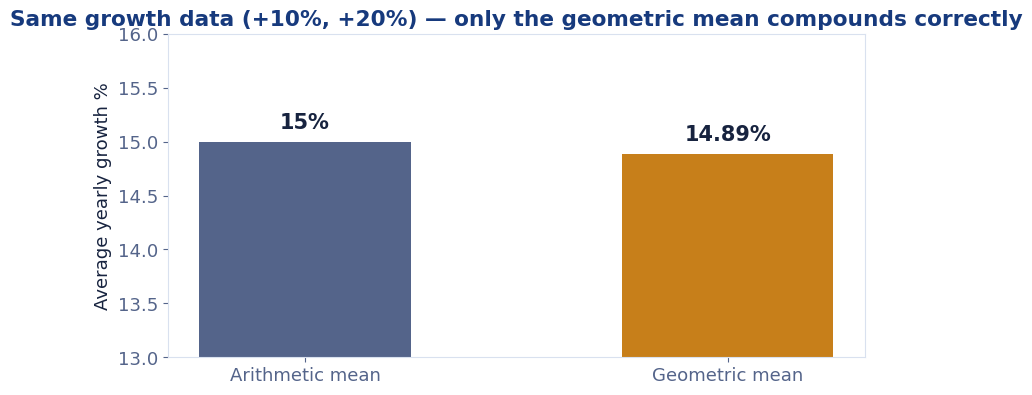
Growth chains by multiplication. $100 that grows 10% becomes $110; growing 20% becomes $132. The two period factors are 1.10 and 1.20, and their product is 1.32. The constant per-period rate reproducing that is √1.32 ≈ 1.1489 — 14.89%, the geometric mean. The arithmetic mean of 10% and 20% is 15%, which sounds harmless — until you check it: $100 × 1.15 × 1.15 = $132.25. The arithmetic mean overstates the ending value. With gentle returns the error is small; with volatile ones it is enormous — a gain of 100% followed by a loss of 50% has an arithmetic mean of +25% and a geometric mean of exactly 0%, which is where the money actually is.
A worked example where the two answers disagree
Three years of returns: +5%, −10%, +25%.
- Arithmetic mean: (5 − 10 + 25) ÷ 3 = 6.67% per year.
- Geometric mean: factors 1.05 × 0.90 × 1.25 = 1.18125; ∛1.18125 ≈ 1.0571 → 5.71% per year.
- Check: $100 at a steady 5.71% for three years ≈ $118.13 ≈ the true ending value of $118.13 (100 × 1.18125). At 6.67% it would claim $121.37 — money that does not exist.
When to use each
| Data | Use |
|---|---|
| Test scores, heights, temperatures, daily totals | Arithmetic mean |
| Investment returns, growth rates, population growth | Geometric mean |
| Ratios and index numbers that chain together | Geometric mean |
| Rates over equal distances (average speed) | Harmonic mean — the third sibling |
| Any set containing zero or negative values | Arithmetic mean (geometric is undefined) |
The ordering is a theorem, not a coincidence: for positive numbers not all equal, harmonic ≤ geometric ≤ arithmetic, always. The gap between the arithmetic and geometric means is a rough volatility gauge — the wilder the swings, the wider the gap.
More guides
Frequently asked questions
What is the difference between arithmetic and geometric mean?
The arithmetic mean adds values and divides by the count; the geometric mean multiplies values and takes the nth root. Use the arithmetic mean for additive data and the geometric mean for growth and returns.
Which mean is right for investment returns?
The geometric mean. +10% then +20% compounds to ×1.32, and √1.32 ≈ 1.1489 — an average of 14.89% per period, not the arithmetic 15%.
Is the geometric mean always smaller?
For positive values that are not all equal, yes: harmonic ≤ geometric ≤ arithmetic. The wider the spread, the bigger the gaps between them.
Can I take the geometric mean of negative numbers?
Not meaningfully — zeros and negatives break the product. Convert percentage changes to growth factors (e.g. −10% → 0.90) and average those instead.